Curatorial essay by Ugonna Ibe-Ejiogu

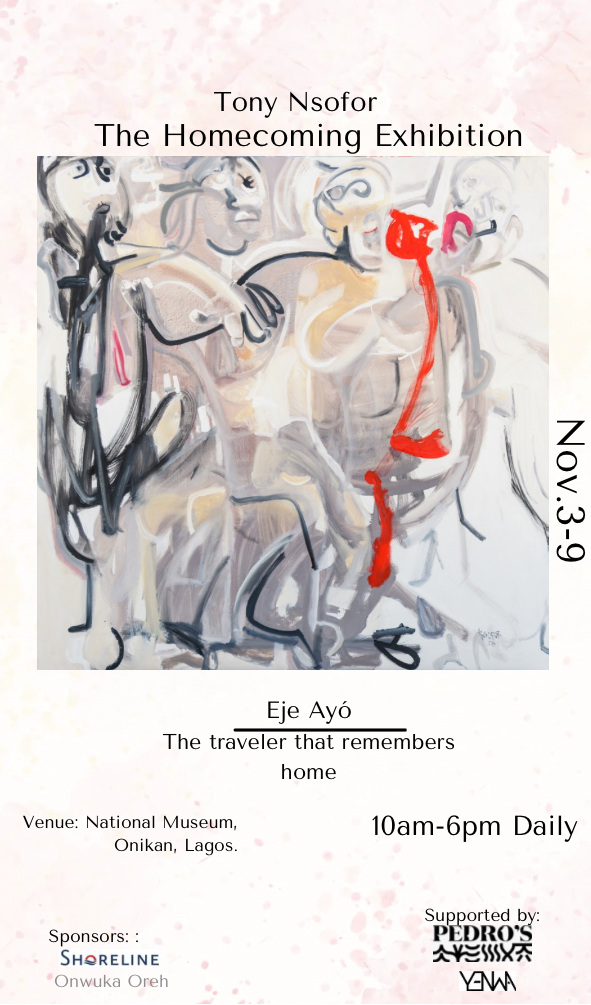
Anthony Nsofor’s return to Nigeria brings together paintings made across Nigeria, Côte d’Ivoire, and the United States. Thirty years after his participation in 6 New Painters from Nsukka, Eje Ayọ considers a practice shaped by movement and renewed attention to the place he calls home. The exhibition asks how travel alters our recognition of what we carry.
Nsofor identifies his American years as a period of heightened awareness of race and ancestry, during which the promise of possibility met the limits imposed by how he was perceived. These experiences renewed his attention to what he had learned elsewhere. Seen together, the paintings suggest that leaving can make aspects of home more present, bringing familiar forms of communal life into contact with new questions about belonging.

The human figure recurs throughout these works. Bodies fill the canvas or become loosely assembled through broad passages of colour, their contours passing between figures until it becomes difficult to establish where one ends and another begins. A face or limb becomes legible within a composition that continues to move around it. Looking involves following these relationships as forms gather and separate across the surface.
In Ofala Festival / A Kingly Harvest, a canvas approximately two metres across, the scale gives the gathering a physical presence before the viewer. Rounded forms turn through warm ochres, reds, and pale pinks, with turquoise interrupting the warmer passages. Broad strokes carry the eye between bodies while darker lines briefly distinguish a head or gesture. The gathering occupies almost the entire surface, leaving little distance from which to observe it.
Painted during Nsofor’s American years, the Ofala Festival can be read as an act of remembering ceremony through paint. The collective occasion takes shape through the proximity of bodies and the rhythms that connect them. What travels here includes a sense of how people gather and occupy space together, allowing home to remain active within a life being lived elsewhere.

Nsofor’s love of colour is evident in the relationships he builds across these works. In Akara / Id, Identity and Idea, cobalt blue gathers near the upper centre while rust brown spreads across the left. Yellow and turquoise draw the eye between figures, while pale passages give the stronger colours room to register. Its broad shapes retain an openness that differs from the tightly worked surface of The Crown Is Near, Wherever You Are. There, dark outlines and repeated curves move through a crowded field of green, pink, and yellow. Colour fills the intervals between lines and occasionally cuts across them. His handling shifts between expansive strokes and closely worked passages, retaining the pleasure of placing one colour against another.
The series title Citizens of Nowhere places a question over many of these gatherings. The figures gather together, yet the title leaves their belonging unresolved. Read alongside the Ofala Festival, the series suggests that people may participate in collective life while remaining uncertain of their position within it. There is also pleasure in proximity, in the company of others, and the possibility of affection. Nsofor’s enjoyment of people extends into the exhibition’s invitations, which carry miniature paintings offered as gifts. The invitation itself becomes an occasion to share something of his practice.
Ancestry introduces a longer measure of belonging. Nsofor’s image of himself within his ancestors’ dreams invites consideration of a life carrying hopes formed before its beginning. The prayers offered for children and unborn descendants give this continuity an intimate expression. Inheritance reaches forward through what people wish to make possible for others.

It also carries responsibilities. In Transitions, Kings and Captives, Nsofor uses storytelling to describe people fleeing oppression who later conquer another community and enslave its inhabitants. This complicates the reassurance that lineage might otherwise provide. Belonging to a history also means considering its consequences for others.
12,000 Ships from Africa / The Clotilda and Others belong to this reckoning. Nsofor connects his investigation of enslavement to his own ancestral position and the possibility of acknowledging responsibility across generations. The title places a named ship within a larger history of forced movement. Across the tall canvas, angular patches of pink and violet cross blues and ochres, with fragments of bodily forms emerging among the accumulated marks. His varied colour and restless handling persist as he turns towards this difficult subject.
Returning to Nigeria gives these concerns another setting. Nsofor describes a period in which he could rest without the immediate pressure to produce. Greater control over his time becomes part of what home offers: the freedom to paint, to think, or to leave the work alone.
Eje Ayọ gathers paintings that have travelled with him, including images of communal life made while he was away. Their return brings those remembered gatherings into proximity with the places and people through which he first understood them. He returns with paintings of home-made elsewhere and with questions that being home does not settle.
The writer, Ugonna Ibe-Ejiogu, is the owner of Yenwa Art Gallery, Lagos.


Comments